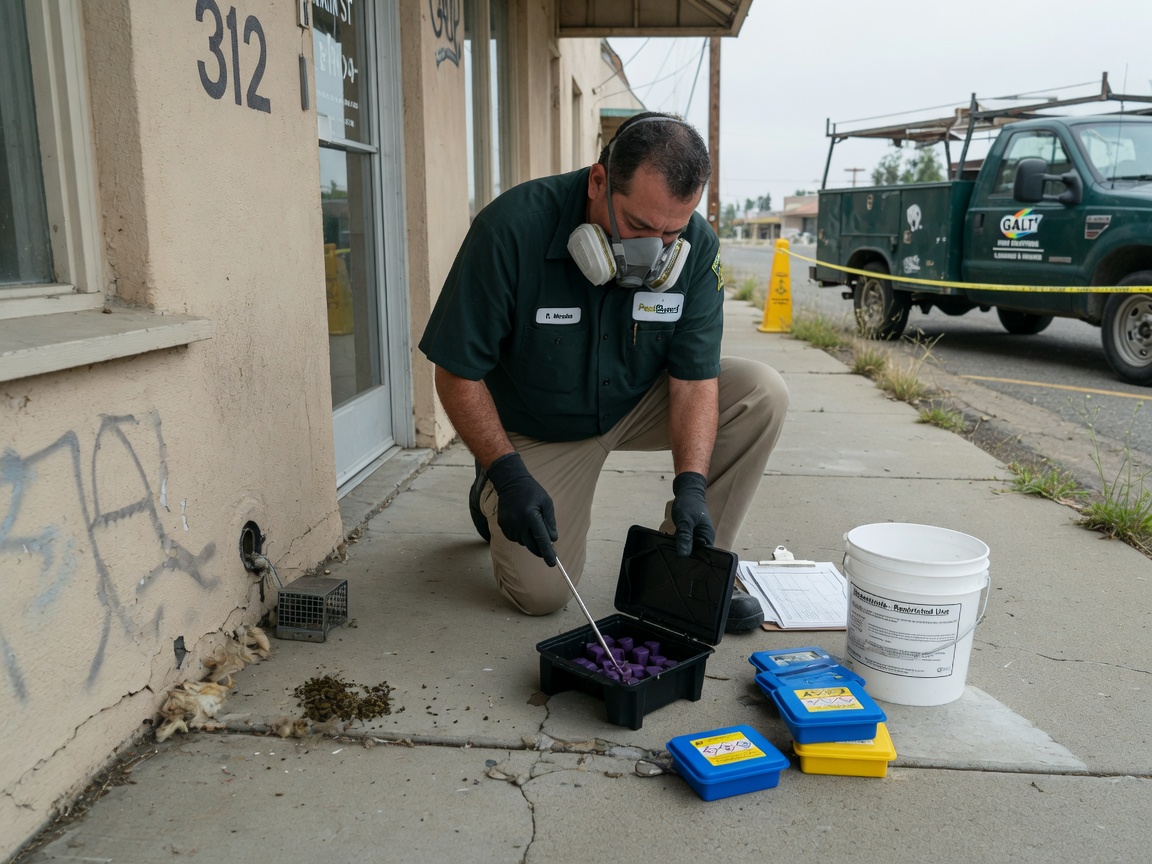
Galt’s cool wet winters push roof rats and house mice indoors through gaps in older single-story homes common near the Historic Galt Depot and Marian Park. Technicians focus on sealing entry points with metal mesh and heavy-duty door sweeps rather than relying solely on bait stations, because wet conditions can wash away exterior treatments. In North Galt and Twin Cities areas, irrigation ditches and mature landscaping create travel corridors that require perimeter checks extending to the property line.
Hot dry summers reduce outdoor food sources, forcing rodents to seek water inside crawl spaces and garages. Exclusion work uses galvanized steel wool packed into pipe penetrations and soffit vents, materials that hold up when temperatures climb above 100 degrees. Homeowners in Downtown Galt often overlook attic access points created by aging roof vents; these must be screened before any trapping begins or the population simply relocates to the next block.
Rodent Control Near You — Choose Your City
Every city below has its own local Rodent Control page with coverage details.
Other areas
Los Angeles
Orange County
San Diego County
San Bernardino County
Contra Costa
San Bernardino
Riverside County
Fresno County
Kern County
Santa Cruz County
Sacramento County building codes require that any structural modifications for rodent exclusion meet current fire and weather standards, so crews document every sealed opening with photos for the homeowner. Edge cases include commercial buildings along the old rail line where grain storage attracts Norway rats; these jobs combine multiple trap types with monthly monitoring because one missed burrow can restart the infestation within weeks.
Technician insight
In Galt the thing that catches most people out with rodent control is how the cool wet winters drive roof rats straight into the older homes clustered around the Historic Galt Depot. Those 1940s–1960s houses have dozens of small gaps that look sealed from the ground but open right up once the rain starts. Skipping the full perimeter check along irrigation ditches in North Galt almost always means the problem returns the next season.
Downtown Galt Home With Persistent Mice
A homeowner near Marian Park noticed droppings in kitchen cabinets each winter. Inspection found gaps under the porch and around dryer vent on a 1950s house. Crew sealed entries with steel mesh, set traps along the foundation, and removed attic nesting material. Activity ended after two follow-up visits and has stayed quiet through the following wet season.
Rodent Control Services We Offer
✓Mice Exclusion Services
Sealing entry points in older Galt homes using steel mesh and door sweeps to stop mice from entering during wet winters.
✓Rat Trapping and Removal
Strategic placement of snap traps and bait stations along irrigation ditches and fence lines in North Galt and Twin Cities neighborhoods.
✓Attic Rodent Cleanup
Removal of nesting material and droppings from attics in homes near Galt Community Park followed by disinfection and insulation repair.
✓Crawl Space Rodent Proofing
Installation of vapor barriers and vent covers to block rats from accessing crawl spaces common in Downtown Galt properties.
✓Commercial Rodent Control
Ongoing monitoring and exclusion for businesses near the Historic Galt Depot where grain and waste attract Norway rats.
Rodent Control Cost in California
| Service | Typical Range | What Affects It |
|---|---|---|
| Initial Rodent Inspection | $125–$200 | Includes full property walk and written report |
| Standard Exclusion Package | $350–$650 | Sealing of 8–15 common entry points on single-story homes |
| Trapping And Removal | $200–$450 | Multiple visits until activity ceases |
| Attic Or Crawl Space Cleanup | $300–$550 | Varies with nesting volume and insulation replacement |
Ranges are typical for California and confirmed with an exact written quote before any work starts.
How it works
- 1
Initial Inspection
Technician walks the full property line checking for droppings, gnaw marks, and entry points around foundations, vents, and utility lines.
- 2
Exclusion Work
All identified gaps are sealed with appropriate materials while avoiding damage to older siding found on many Galt homes.
- 3
Trapping And Monitoring
Snap traps and bait stations are placed along established runways; stations are checked every 48 hours until activity stops.
- 4
Follow-Up Visit
Final walkthrough confirms no new signs and reviews seasonal prevention steps with the homeowner.
Pricing
Upfront quotes provided after inspection; final cost depends on property size and extent of entry points.